
Executive Summary
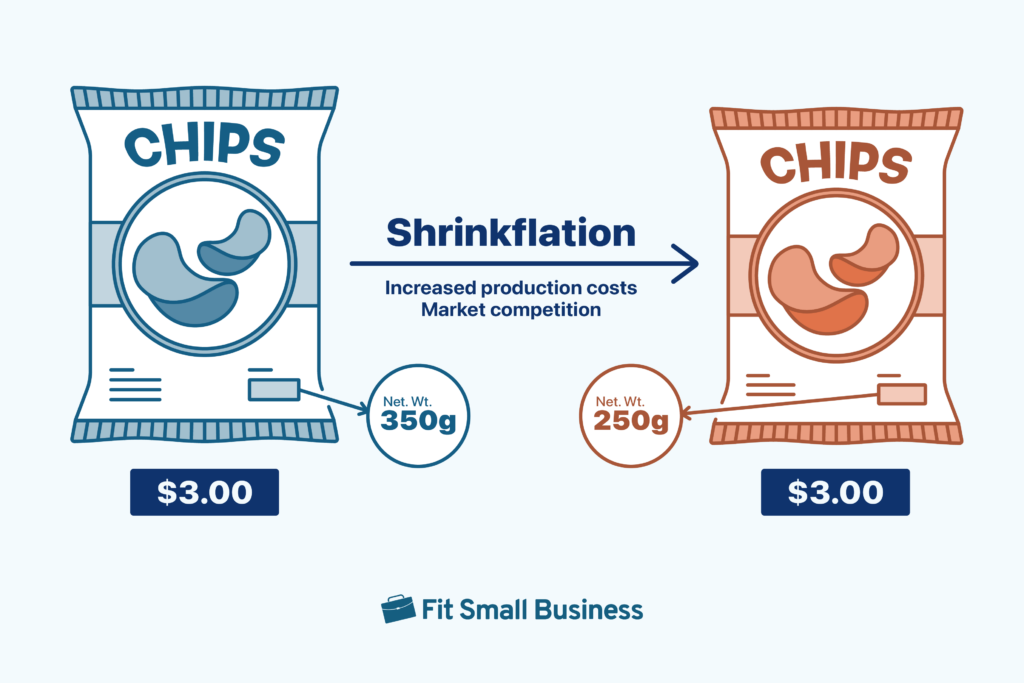
Shrinkflation—the practice of reducing a product's weight, volume, or quantity while maintaining or increasing its price—is generally legal in most market economies, including the United States, the European Union, and the UK. However, its legality is contingent upon compliance with a complex web of consumer protection laws, labeling regulations, and fair trading standards. It is a business strategy that operates in a legal gray area, where the line between acceptable cost management and deceptive practice is defined by specific actions and disclosures.
1. The Core Legal Principle: The Absence of Price Control
In free-market economies, there is generally no law fixing the price of most goods or the quantity/volume offered at that price. A manufacturer or retailer has the legal right to:
Change a product's formulation.
Change its size.
Change its price.
They are not legally obligated to maintain a consistent unit size or price over time. The core transaction is a contract where the seller offers a product with specific attributes at a stated price, and the buyer chooses to purchase it or not.
2. The Critical Legal Constraint: The Prohibition of Deception
While companies have broad discretion, the primary legal boundary is deceptive or unfair trade practices. Shrinkflation becomes illegal when the changes are deliberately obscured to mislead a reasonable consumer into believing they are getting the same (or better) value as before.
This is where specific laws come into play:
A. Labeling Regulations (The Most Direct Legal Framework)
This is the most important area of law governing shrinkflation. The requirement is for accurate and transparent disclosure of the net quantity.
In the United States, the Fair Packaging and Labeling Act (FPLA) and its enforcement by the Food and Drug Administration (FDA) and Federal Trade Commission (FTC) mandate that the net quantity of contents be declared prominently, conspicuously, and accurately on the principal display panel of the package. The font size is even dictated by the package's size.
Legality Test: If the package clearly states the new, reduced weight (e.g., "12 oz" instead of the previous "16 oz"), it is almost certainly legal. The crime would be to keep the old weight on the label.
The FTC's "Unfair or Deceptive Acts or Practices" authority can be invoked if the packaging is designed to hide the size reduction (e.g., false bottoms, excessive slack-fill, or packaging that remains identical in external dimensions despite less content).
In the European Union and the United Kingdom, similar stringent regulations exist (EU Regulation 1169/2011 on Food Information to Consumers, UK Food Information Regulations). The net quantity must be expressed in metric units (grams, liters, etc.) in a minimum font size. Failure to accurately state the quantity is a direct legal violation.
"Slack-Fill" Laws: Many jurisdictions have specific laws against non-functional slack-fill—unnecessarily large packaging that creates a false impression of volume. If shrinkflation is accompanied by packaging that is misleadingly large for the new, reduced product, it can be illegal.
B. Consumer Protection Laws
Broad consumer protection statutes provide a backstop against deceptive shrinkflation.
In the U.S., the FTC Act prohibits "unfair or deceptive acts or practices."
In the UK, the Consumer Protection from Unfair Trading Regulations 2008 ban misleading actions and omissions.
In the EU, the Unfair Commercial Practices Directive serves the same purpose.
What constitutes a violation under these laws?
Active Deception: Making false claims like "New!" or "Improved!" when the only change is a size reduction.
Omission of Material Information: Failing to disclose the size reduction in a way that a typical consumer would notice, especially if the price per unit (e.g., price per ounce) is not provided and the old and new packages are virtually indistinguishable.
Exploiting Consumer Habits: Relying on the fact that consumers are creatures of habit and won't check the net weight, with the intent to deceive them about the value.
C. Unit Pricing Regulations
Some jurisdictions (like many U.S. states and EU countries) require unit pricing on shelf labels (e.g., price per 100g or per ounce). This is a powerful tool for consumers to detect shrinkflation. While the absence of unit pricing doesn't make shrinkflation illegal, its presence is a legal mitigation against claims of deception, as it provides the information needed for direct comparison.
3. The Gray Areas and Ethical Debates
The law often lags behind business innovation in obfuscation. Key gray areas include:
Stealth Redesigns: Slightly altering the shape of a product (e.g., making a candy bar thinner with more pronounced grooves) or using denser ingredients to make the reduction less visually apparent, even with a correct weight label. This tests the boundaries of "deceptive design."
Simultaneous "Improvement": Coupling a size reduction with a minor recipe change (e.g., "now with 10% more protein!") to justify the change and deflect attention from the net weight loss.
Psychological Tricks: Using "value-size" packaging for a product that is actually smaller than the original "regular" size from a few years prior, resetting consumer expectations.
While ethically questionable, these tactics are legally defensible if the net quantity is accurately labeled.
4. Legal Precedents and Enforcement Actions
Enforcement is Rare but Exists: Governments typically pursue clear-cut cases of labeling fraud rather than shrinkflation per se. For example, a company selling a box labeled "16 oz" that contains only 14 oz would face severe fines and sanctions.
FTC Actions: The FTC has historically brought actions against egregious slack-fill (like in the case of certain breath mint containers). It has issued guidance warning that "size changes should be communicated clearly and conspicuously."
Civil Lawsuits: Shrinkflation occasionally leads to class-action lawsuits alleging fraud and violation of state consumer protection laws. The success of these suits hinges on the plaintiff's ability to prove the company intentionally hid the change to deceive consumers, not merely that the change occurred. Many are dismissed if the labeling was accurate.
5. Comparative Legal Perspectives
France: Has taken one of the most aggressive stances. In 2022, it passed a law requiring explicit notification of shrinkflation. Retailers must display a clear sign for at least two months informing consumers when a product's quantity is reduced while its price stays the same. This is a unique legal move beyond mere labeling accuracy, aimed at forcing transparency.
South Korea: Requires manufacturers to notify retailers of size reductions, and retailers are encouraged to post notices.
Conclusion: Legal, But with Transparent Labeling as the Key Safeguard
Shrinkflation is a legal business strategy, provided the seller complies with the foundational requirement of all consumer goods markets: accurate labeling of the net quantity.
The legal risk for a company lies not in reducing size, but in:
Falsifying the net quantity label.
Designing packaging to actively deceive or hide the reduction (slack-fill).
Making accompanying claims that are false or misleading.
For consumers, the law provides the tool of transparency (the net weight label and unit price), but places the onus on them to be vigilant. The recent legislative movements in countries like France indicate a growing political awareness of the practice, suggesting that while shrinkflation remains legal, the regulatory pressure for more prominent disclosure may increase in the future. It sits firmly in the realm of corporate ethics and consumer savvy, with the law acting as a guardrail against outright fraud, not against the economic strategy itself.