
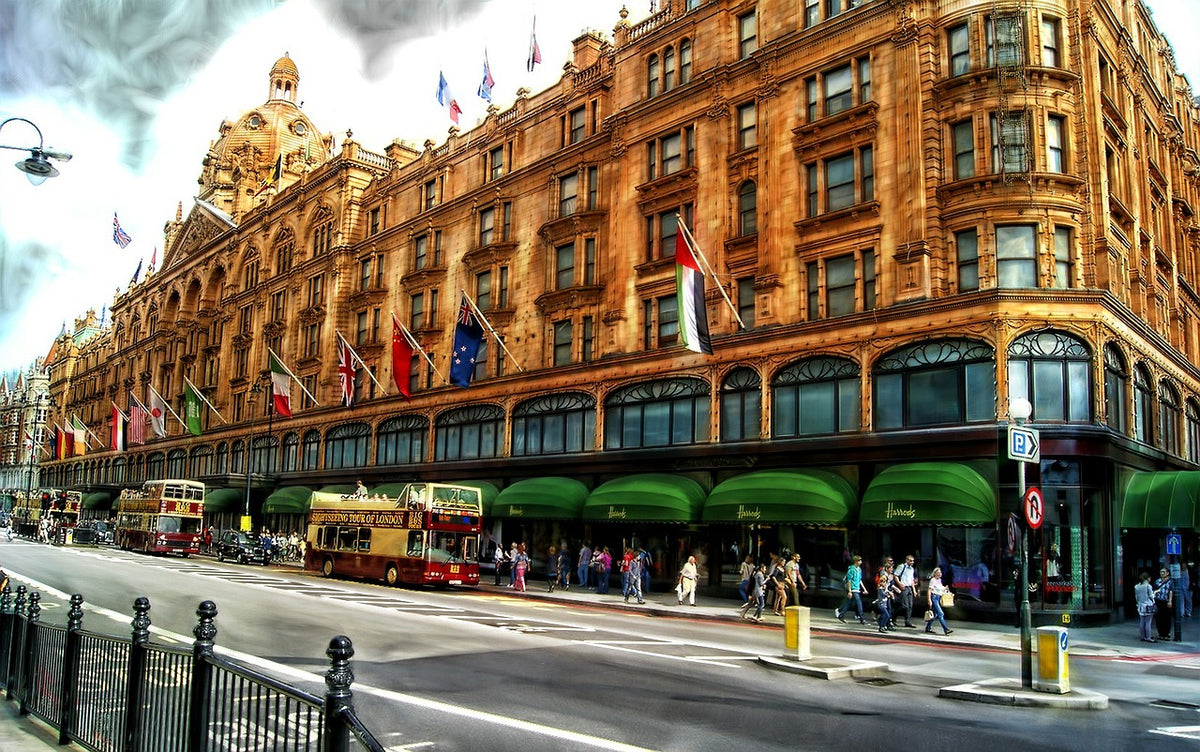
Harrods is not merely a department store; it is a densely woven tapestry of commerce, history, social aspiration, and theatrical excess. Occupying a prime 5-acre site in Knightsbridge, London, its 330 departments across seven floors (1.1 million square feet of retail space) represent a self-contained universe where the philosophy is "Omnia Omnibus Ubique"—All Things for All People, Everywhere. But this Latin motto only scratches the gilded surface.
I. Historical Foundations: From Grocer to Crown Jewel
The story begins in 1834, not with opulence, but with modest enterprise. Charles Henry Harrod took over a small grocery and tea business in Stepney. His son, Charles Digby Harrod, propelled its growth, moving to the nascent Brompton Road location in 1849. The store's defining moment came in 1883, when a devastating fire destroyed the building just before Christmas. Harrod famously promised customers their orders would be fulfilled, and through herculean effort, he did, building immense goodwill and the grander store that stands today.
The architectural marvel we recognize—the terracotta façade, the Byzantine dome, and the intricate Edwardian Baroque details—is largely the work of Charles William Stephens, commissioned by the new owner Richard Burbidge after the Harrod family sold the business in 1889. The iconic green-and-gold liveried doormen and the elaborate Food Halls with their stunning Art Nouveau tiles (designed by W. J. Neatby in 1902) date from this era of explosive growth, establishing Harrods as the supplier to the elite of the British Empire.
II. The Al-Fayed Era: Gilded Opulence and Controversy
The modern mythology of Harrods is inextricably linked to Mohamed Al-Fayed, who acquired it in 1985. His ownership was a masterclass in grandiose personal branding. He infused the store with an almost overwhelming sense of theatrical spectacle:
The Egyptian Escalator: The centerpiece of his reign. A mock-Egyptian monument dedicated to his son Dodi and Diana, Princess of Wales, featuring bronze sphinxes, pharaonic statues, and a mosaic-lined escalator shaft. It was a controversial, personal memorial that turned a retail space into a shrine.
The Luxury Assortment: Al-Fayed aggressively pursued the world's most exclusive brands, creating dedicated "rooms" for luxury houses. He understood that Harrods wasn't just selling products; it was selling access and validation.
The Christmas Grotto: Under his ownership, it became the most famous and elaborate in the world, a pilgrimage site for families, requiring tickets booked months in advance.
This era cemented Harrods' reputation as a tourist attraction equal to Buckingham Palace, but it was also marked by a very public feud with the British establishment and, eventually, the Qatari Royal Family's acquisition in 2010.
III. The Harrods Experience: A Deep Dive into its Realms
To walk through Harrods is to traverse a series of curated worlds:
The Ground Floor & Food Halls: A controlled chaos of perfumes, accessories, and the breathtaking Food Halls. Here, the sense of abundance is religious. The Meat Hall with its cathedral-like dome and frescoes of pastoral scenes, the Fish Hall with its marble counters and stained glass, present food as high art. It’s a gallery where the produce is both exhibit and sacrament.
The Luxury Rooms (First Floor): A labyrinth of discrete, hushed salons for haute couture, fine jewelry, and watches. This is where serious wealth is transacted in near-silence. The Salon de Parfums is a particular marvel—a vault of rare and exclusive fragrances, some costing tens of thousands of pounds.
The Superbrand Spaces: Harrods doesn't just have a section for Louis Vuitton or Chanel; it has dedicated, store-within-a-store emporiums, often with exclusive product lines. The Toy Kingdom and Pet Kingdom are realms of fantasy, selling everything from life-sized stuffed giraffes to diamond-encrusted dog collars.
The Upper Floors & Services: Here, "Omnia Omnibus" truly manifests. You can furnish a mansion (Harrods Interior Design), commission a bespoke suit, get a haircut, consult a personal shopper, plan a wedding, book a holiday, or even arrange funeral services (a legacy of its founding as a grocer that delivered). It is a one-stop shop for an entire aristocratic lifestyle.
IV. The Unwritten Rules & Cultural Currency
Harrods operates on its own internal logic:
The Famous Green Bags: More than a carrier, they are a status symbol, a visible token of participation in the Harrods economy. The store's signature dark green and gold are protected trademarks.
The Dress Code: While relaxed for tourists, an unspoken expectation of "smart attire" lingers, especially in the luxury areas. It is a space where one performs affluence.
The Harrods Sale: A biannual event that is less a sale and more a social phenomenon—a genteel, yet fiercely competitive, scramble for luxury at a discount. Queues form overnight, a ritual of consumerism.
The Customer Base: A fascinating ecosystem of ultra-high-net-worth individuals (the "HNWIs" who have personal account managers), aspirational middle-class tourists experiencing a once-in-a-lifetime splurge, and Londoners using specific, trusted departments like the Butchery or Pharmacy.
V. Modern Paradoxes & Future
Today, owned by Qatar Investment Authority, Harrods balances its historical weight with modern demands. It faces the challenge of maintaining its unique, slightly anachronistic character while competing in a globalized luxury market and an era of digital commerce.
Its paradox is its core strength: it is simultaneously a museum of retail history, a temple of consumption, a tourist landmark, and a practical, if exceedingly grand, department store. It can be criticized as a monument to excess, a gilded cage of materialism. Yet, it remains undeniably magnetic—a living, breathing archive of social history, taste, and ambition.
In essence, Harrods is a microcosm of London itself: layered, historical, sometimes imperious, endlessly fascinating, and perpetually renewing itself while steadfastly clinging to the rituals and splendors of its past. It is not just a place to shop; it is a world to be explored, a spectacle to be witnessed, and a powerful statement of commerce's enduring capacity to dazzle.